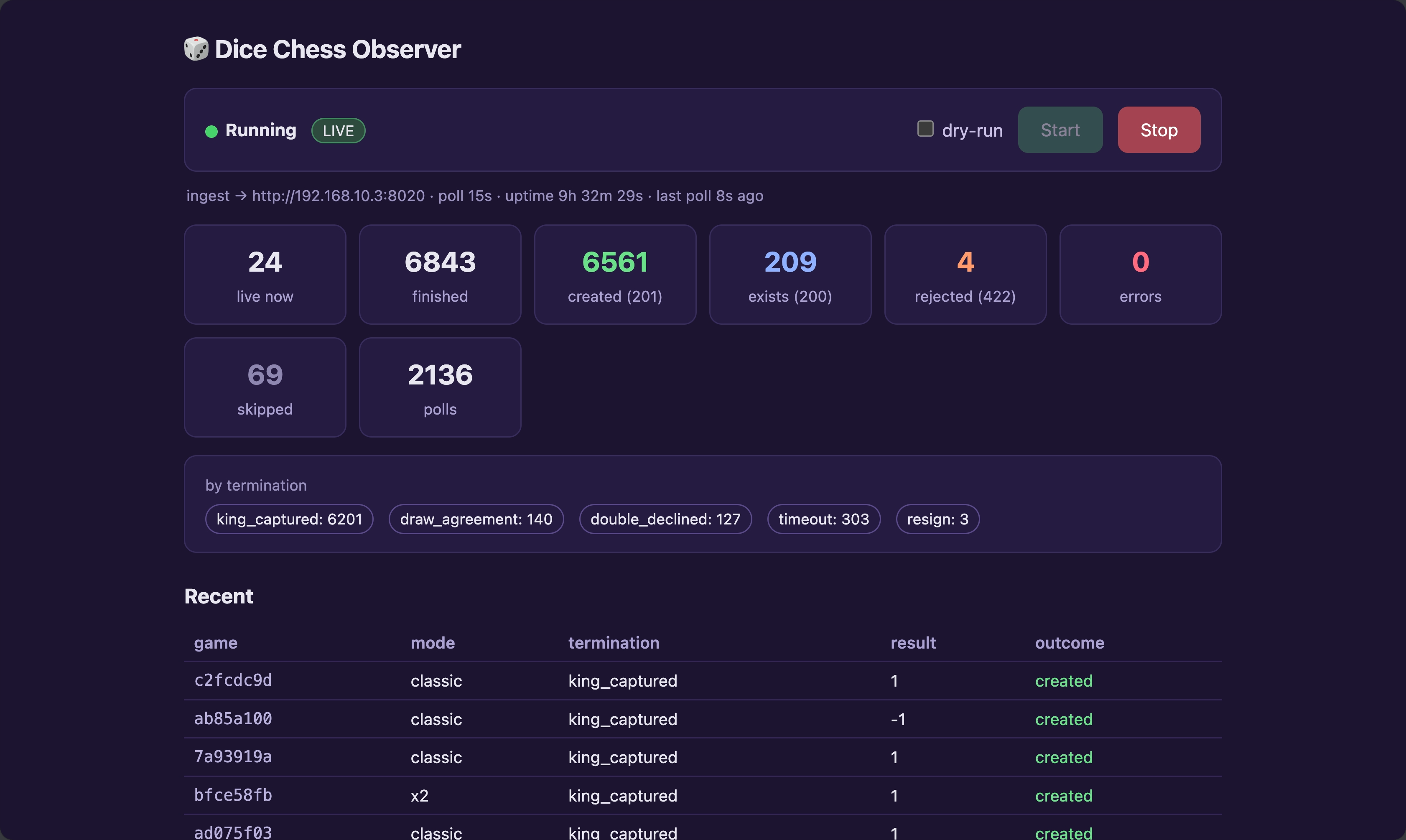
Code Review: dicechess-observer
I have reviewed the core files of the dicechess-observer microservice (config.ts, server.ts, service.ts, observer.ts, dicechess.ts, assemble.ts, ingest.ts).
Overall, the codebase is excellent. It is clean, strongly typed, and separates concerns well. Here are my specific observations:
🌟 The Good
- Clean Separation of Concerns: The logic is well partitioned.
dicechess.tshandles the quirk of Cloudflare blockingundiciby cleanly wrappingcurlviaexecFile.observer.tsperfectly encapsulates the polling loop state and lifecycle.normalize.ts/assemble.tspurely handles the domain logic of transforming raw states into the clean analytics schema.
- Graceful Shutdown: In
service.ts, hooking intoSIGINTandSIGTERMto callobserver.stop()and waiting for the loop promise to resolve is a textbook example of how to implement graceful shutdown in Node.js. - Security: Using
execFileinstead ofexecindicechess.tsprevents any shell injection attacks, even ifjwtorgameIdcontained shell meta-characters. The headers and URL are passed safely as direct OS arguments. - Idempotency & Resiliency: The
observer.start()is cleanly idempotent, and errors inside theobserver.loop()catch and log without crashing the whole process (incrementingstats.errors), ensuring the observer recovers on the next interval.
⚠️ Minor Issues / Suggestions
1. POLL_INTERVAL_MS empty string fallback
In src/config.ts:
pollIntervalMs: Number(process.env.POLL_INTERVAL_MS ?? 15_000),If a user adds POLL_INTERVAL_MS= (empty string) to their .env, process.env.POLL_INTERVAL_MS will be "". The ?? operator only catches null or undefined, so it evaluates to Number(""), which is 0.
This would cause sleep(0) and hammer the API continuously in a tight loop.
Fix Recommendation:
Use the logical OR operator (||) instead of nullish coalescing (??), which treats "" (and 0) as falsy, ensuring it gracefully falls back to 15_000:
pollIntervalMs: Number(process.env.POLL_INTERVAL_MS || 15_000),2. Typo in readJsonBody catch block
In src/server.ts, if the incoming HTTP request is aborted abruptly (req.on("error")), it resolves readJsonBody with {}. This is perfectly safe for this specific use-case, but generally, ignoring stream errors silently can sometimes hide network issues. Given this is just a local control panel, it is perfectly fine.
3. JWT validation
In src/config.ts, the DICECHESS_JWT is trimmed and the Bearer prefix is removed. This is very robust. You might also want to do a simple length check or format check on startup (in service.ts) just to warn the user early if the JWT looks visibly malformed, rather than waiting for curl to return a 403 or 401.
Conclusion
The architecture is solid and completely fit for purpose. The use of curl to bypass Cloudflare is an effective pragmatic choice. The minimal HTTP server (node:http) avoids dragging in heavy dependencies like Express for what is essentially a single HTML page and two API endpoints. Excellent work!